
Why We Built a Free Interest Calculator for Deposits, Savings and Loans
· 5 min read
Contents
Our first blog post introduces the Financial Calculators: why we built them, what the deposit, savings and loan calculators compute and how, and what they deliberately leave out — with real screenshots and numbers.
Why we built it
An interest rate looks like a single number, but it rarely tells you how much money actually ends up in (or leaves) your account.
- A 4.5% term deposit pays less than 4.5% once tax on the interest is taken out.
- A 4.5% savings plan, where you deposit every month, earns far less interest than a 4.5% deposit of the same total — each payment sits in the account for a different length of time.
- A 6.5% mortgage over 30 years can cost more in interest than the amount you borrowed, and the total depends heavily on how you repay.
We wanted a calculator that answers these questions instantly, built on a few principles:
- No sign-up, no install — open the page and the numbers are already there.
- Show what you actually keep or pay, including tax where it applies.
- Publish the formulas and rounding rules, and verify them with automated tests.
- Keep your numbers private: everything is calculated in your browser and nothing is sent to a server.
- Work in English and Korean. The English pages default to US dollars, and you can switch to Korean won.
Deposit interest calculator
The deposit calculator works out the interest on a fixed-term deposit or certificate of deposit (CD), where you put in a lump sum once. Enter the amount, the annual rate, the term in months and how the interest is taxed — results update as you type.
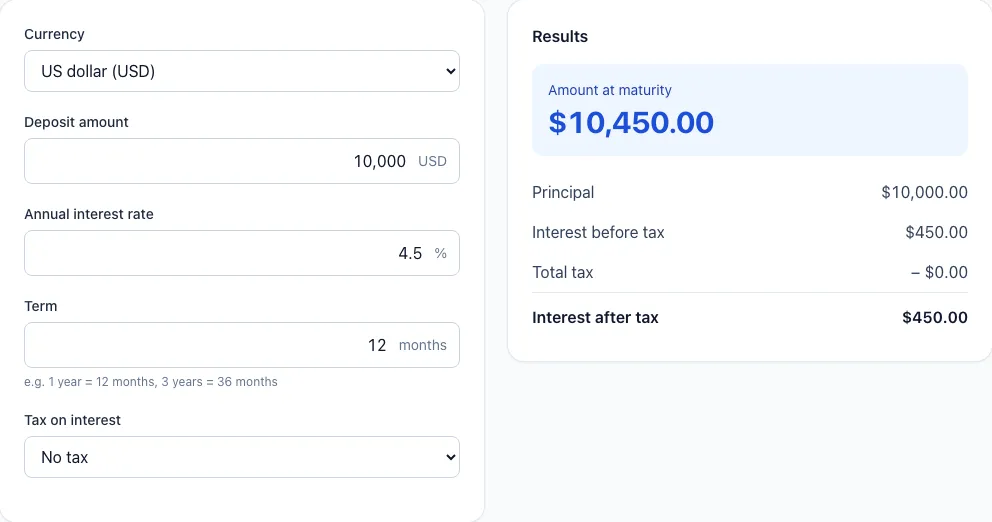
It uses simple interest paid at maturity, the most common structure for term deposits:
- Interest before tax = Principal × Annual rate × Months ÷ 12
- Interest after tax = Interest before tax − Tax
- Amount at maturity = Principal + Interest after tax
$10,000 at 4.5% for 12 months earns $450.00 before tax, for $10,450.00 at maturity. Tax rules differ by country, so you can choose no tax, a custom rate (for example, your marginal income tax rate), or the Korean standard rate of 15.4%. With a 22% custom rate, the same deposit keeps $351.00 of interest.
Savings interest calculator
The savings calculator is for plans where you deposit the same amount every month.
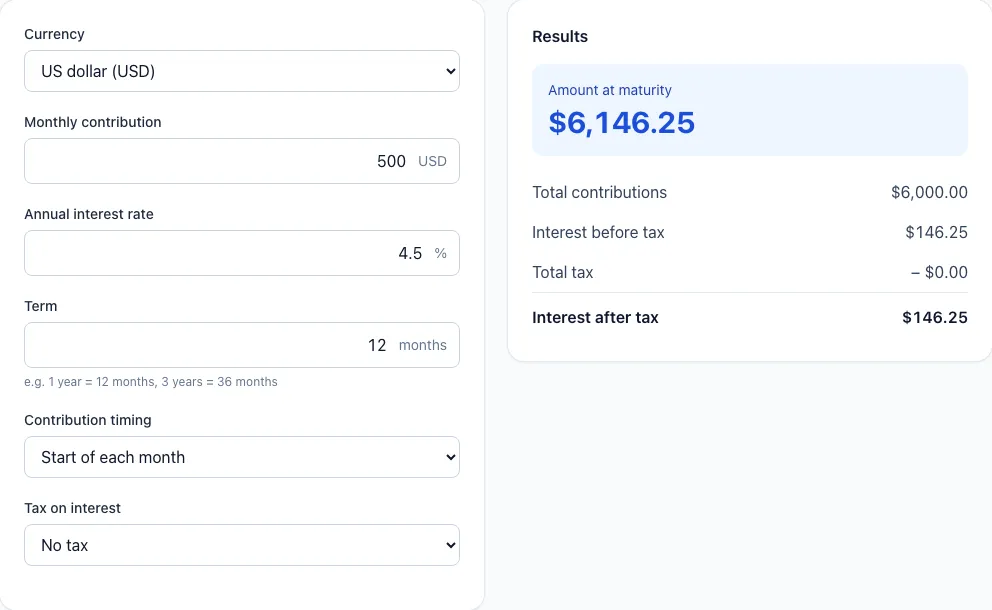
The key difference from a deposit is that each payment earns interest for a different number of months. If you pay at the start of each month, the first payment earns 12 months of interest and the last one earns just one. Over 12 months, that adds up to 1 + 2 + … + 12 = 78 “deposit-months”.
- Interest before tax = Monthly payment × Annual rate ÷ 12 × (sum of months each payment is held)
At $500 a month and 4.5% for 12 months, that is $500 × 4.5% ÷ 12 × 78 = $146.25 of interest on $6,000 of contributions, for $6,146.25 at maturity.
Had you deposited the full $6,000 on day one, you would have earned $270.00 — so a savings plan at the same rate earns a little over half as much. You can also choose to pay at the end of each month, in which case the last payment earns no interest.
Loan payment calculator
The loan calculator shows the monthly payment, total interest and a full amortization schedule for a fixed-rate loan.
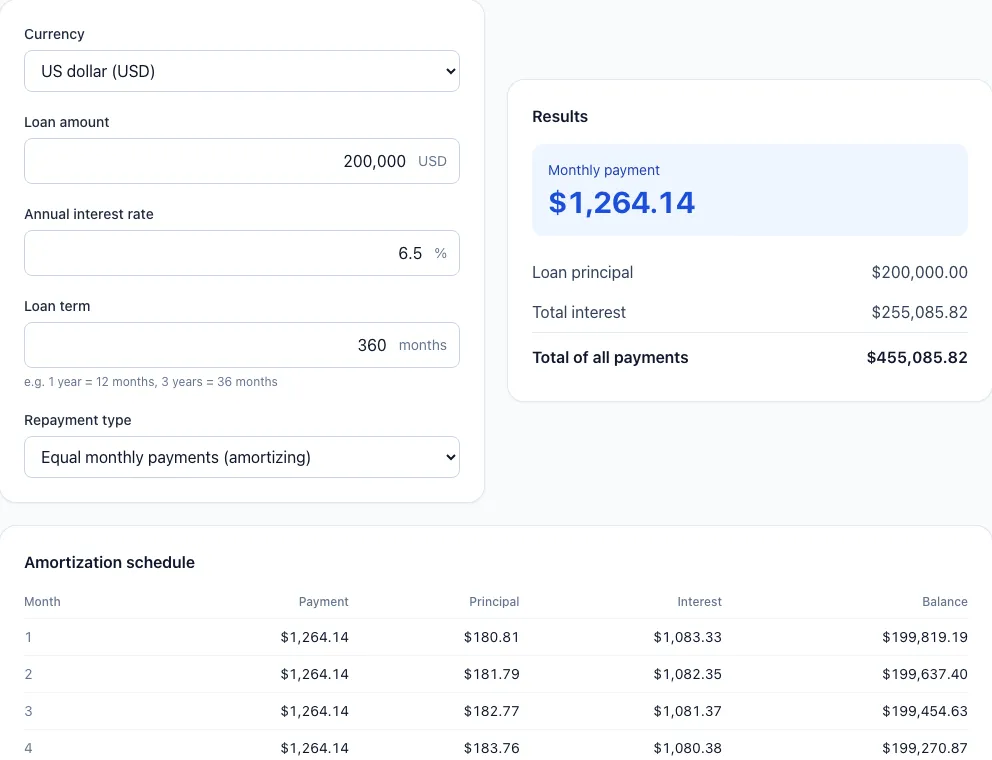
Each month, interest is charged on the remaining balance × (annual rate ÷ 12). Three repayment types are supported, and they lead to very different totals for the same loan:
| Repayment type | What you pay each month | Total interest |
|---|---|---|
| Equal monthly payments | $1,264.14 every month | $255,085.82 |
| Equal principal payments | $1,638.88 in month one, falling to $560.57 | $195,543.64 |
| Interest-only (balloon at end) | $1,083.33 interest, then $200,000 at the end | $389,998.80 |
Based on $200,000 at 6.5% over 360 months
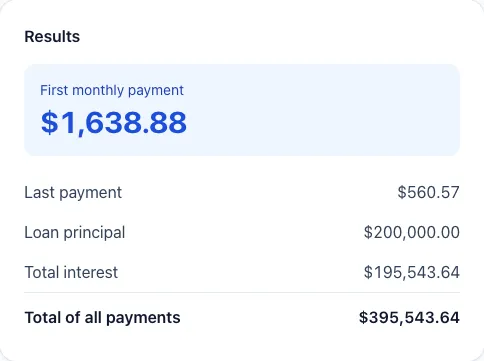
- Equal principal payments pay the balance down fastest, so total interest is lowest — but the early payments are the largest.
- Equal monthly payments (a standard amortizing mortgage) keep every payment the same, which makes budgeting easy.
- Interest-only keeps monthly payments lowest, but because the balance never shrinks, total interest is highest and the full principal is due at the end.
The amortization schedule below the results shows how each payment splits into principal and interest. With equal monthly payments, $1,083.33 of the first $1,264.14 payment is interest; the principal share grows every month after that. For a deeper comparison, see the guide to loan repayment methods.
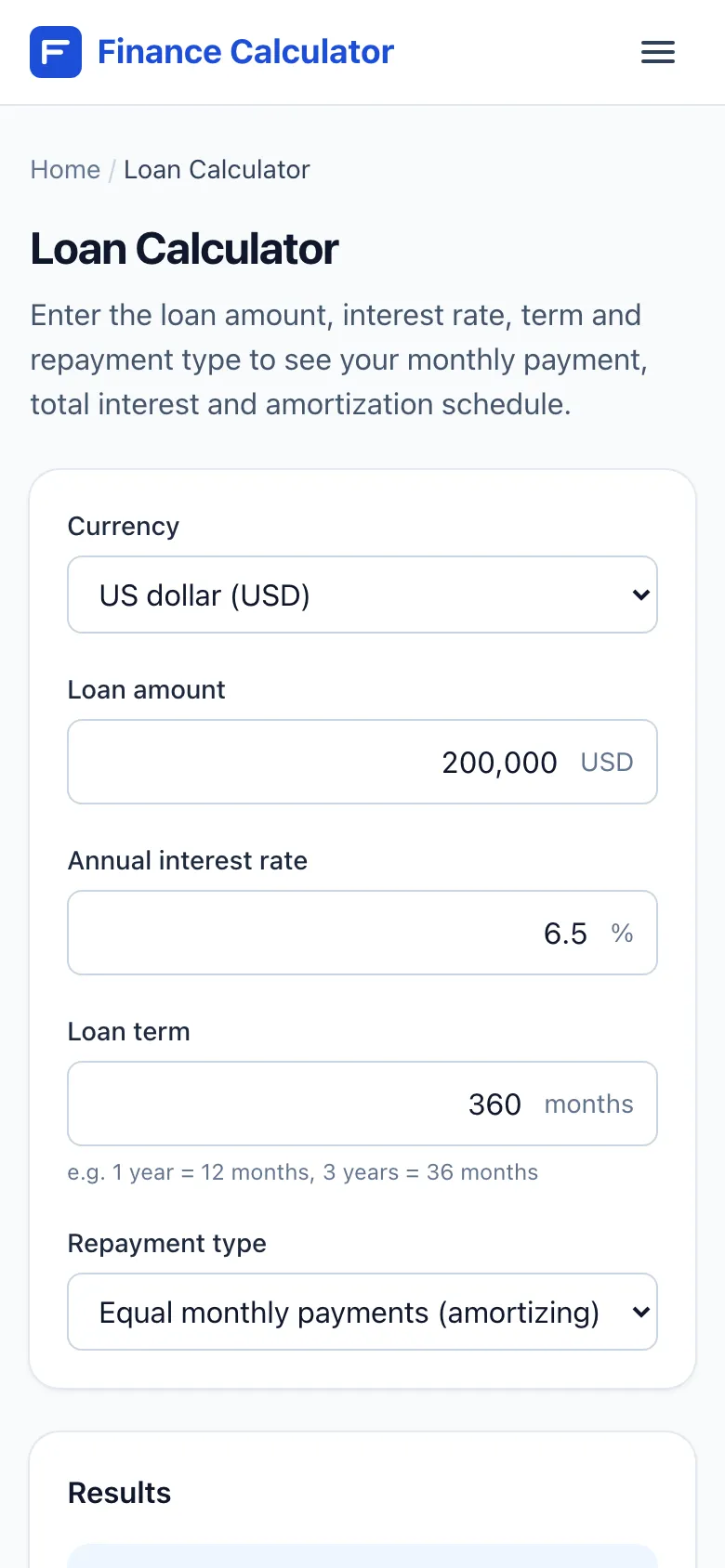
On a phone, the inputs and results stack vertically, and the wide amortization schedule scrolls sideways within its own box.
How the calculations work
The calculation engine is a set of plain TypeScript functions, separate from the page, and it runs entirely in your browser. A few rules keep the results trustworthy:
- Money is stored as whole units — cents for US dollars, won for Korean won — so rounding errors cannot pile up. Large amount × rate × term products are computed with big integers (BigInt) to avoid losing precision.
- Rounding is defined up front. Deposit and savings interest is rounded down to the cent; monthly loan interest is rounded to the nearest cent, and any leftover from rounding is settled in the final payment.
- The rules are tested. Unit tests check invariants such as “the principal portions add up to the loan amount” and “the final balance is zero”, along with the worked examples in the calculation rules. Every number in this post comes straight from the live calculator.
- Your inputs live in the page address. Changing a value updates the URL query, so you can copy the link to share exactly the same calculation.
What the calculators don’t cover
The results are estimates for planning. The current version does not account for:
- Daily interest based on the actual number of days (one month is treated as 1/12 of a year)
- Compounding products or bonus-rate conditions
- Early withdrawal penalties or prepayment fees
- Variable rates, interest-only grace periods before amortization, taxes and insurance bundled into mortgage payments
If your lender’s figure differs by a few cents or dollars, it is usually because of daily interest or a first payment period that isn’t exactly one month. Always confirm the final numbers with your bank before you commit.
Try it yourself
When you compare rates, what matters is how much you keep after tax and how much you repay in total, not the headline number. Plug in the deposit, savings plan or loan you are considering at the Financial Calculators. In upcoming posts, we will introduce the other games and tools on Kola Tools one by one.