
How Much Does Half a Percent or Five More Years Add to Your Loan?
· 3 min read
Contents
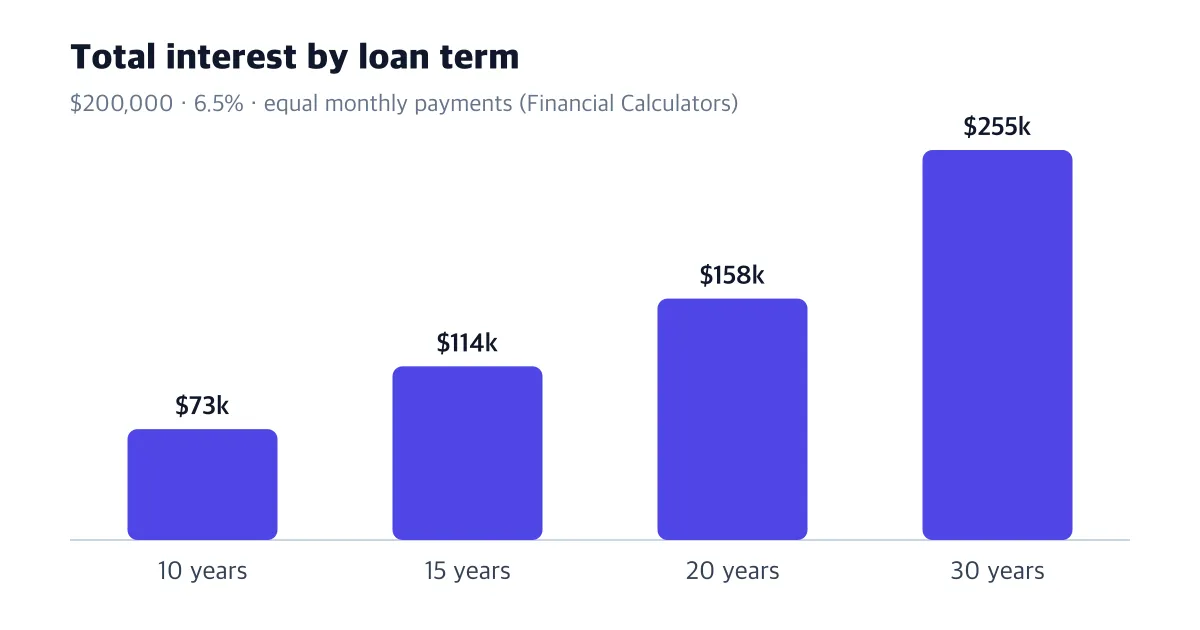
When you shop for a loan, half a percentage point or five extra years can look minor. Over a loan you repay for decades, though, they change the total interest by tens of thousands of dollars. Using a $200,000 loan as an example, we changed the rate and the term one at a time in our loan calculator to see exactly how much the monthly payment and total interest move.
All figures assume a fixed rate and equal monthly payments, calculated with our Financial Calculators. They’re estimates: real loans can differ because of daily interest, fees, discounts, and taxes and insurance bundled into mortgage payments.
The setup
- Loan amount: $200,000
- Repayment: equal monthly payments (a standard amortizing loan)
- Baseline: 6.5% for 30 years (360 months)
- One change at a time: rates from 5.5% to 7.5%, terms from 10 to 30 years
When the rate rises by half a point
We kept the term at 30 years and changed only the rate.
| Rate | Monthly payment | Total interest | Extra interest vs. previous row |
|---|---|---|---|
| 5.5% | $1,135.58 | $208,806.90 | — |
| 6.0% | $1,199.10 | $231,677.04 | +$22,870.14 |
| 6.5% | $1,264.14 | $255,085.82 | +$23,408.78 |
| 7.0% | $1,330.60 | $279,021.94 | +$23,936.12 |
| 7.5% | $1,398.43 | $303,433.66 | +$24,411.72 |
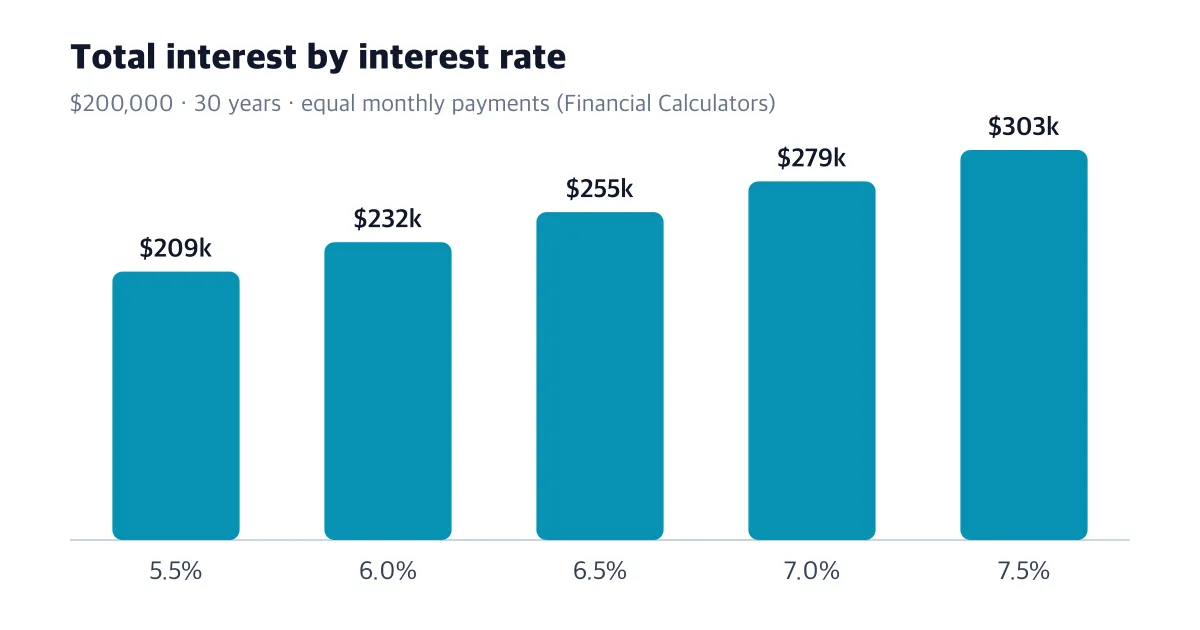
- Each half point adds about $65 a month and roughly $23,000 in total interest. Sixty-five dollars sounds small, but 360 payments add up.
- Comparing 5.5% with 7.5%, the payment differs by $262.85 a month and total interest by $94,626.76.
- The higher the rate, the more each additional half point costs.
When the term gets longer
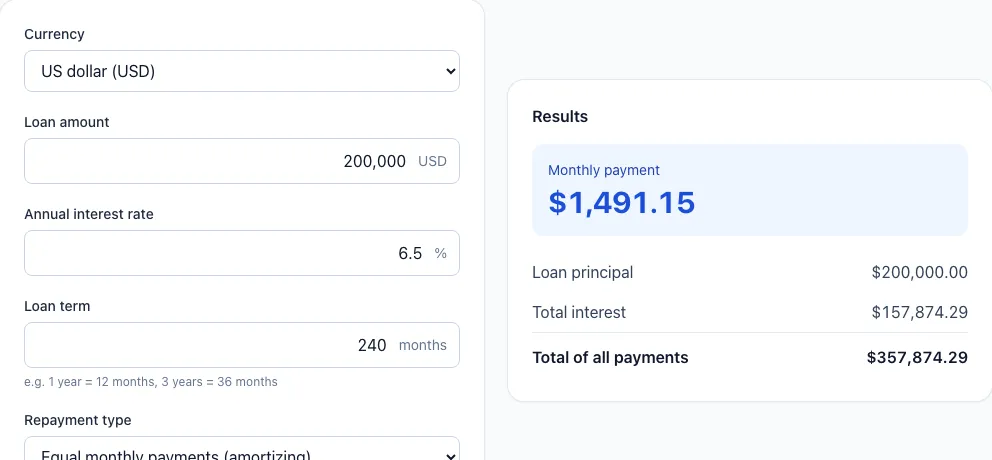
Next, we kept the rate at 6.5% and changed only the term.
| Term | Monthly payment | Total interest |
|---|---|---|
| 10 years | $2,270.96 | $72,515.05 |
| 15 years | $1,742.21 | $113,599.25 |
| 20 years | $1,491.15 | $157,874.29 |
| 30 years | $1,264.14 | $255,085.82 |
A longer term lowers the monthly payment but raises total interest — and the trade gets worse the longer you go.
- 15 vs. 30 years: the 30-year loan costs $478.07 less per month, but $141,486.57 more in total interest.
- 20 vs. 30 years: you save only $227.01 a month by stretching to 30 years, yet pay $97,211.53 more in interest.
On the 30-year loan, total interest ($255,085.82) is more than the $200,000 you borrowed. If you can manage a higher payment, a somewhat shorter term saves a lot.
Putting the numbers to work
- Start from the payment you can comfortably afford. Within that budget, the shortest term costs the least in interest.
- Compare rates in dollars, not decimals. Plug offers like “0.3 points lower” into the calculator to see the real difference.
- Try other repayment types too. Equal principal payments cost less interest than equal monthly payments but start with higher payments. See our guide to loan repayment methods for details.
- Save or share the result link. The calculator keeps your inputs in the page address, so you can bookmark each scenario and reopen it later.
What the calculation leaves out
These numbers assume a fixed rate and payments on the same day each month. They don’t include variable rates, interest-only periods, prepayment fees, discounts, daily interest, or property taxes and insurance that are often bundled into US mortgage payments. Before you commit, confirm the real terms with your lender.
The bottom line
Half a point and five years look small on paper, but across a whole loan they’re worth tens of thousands of dollars. Plug your own numbers into the loan calculator to compare. We introduced the Financial Calculators and why we built them in our first post.